
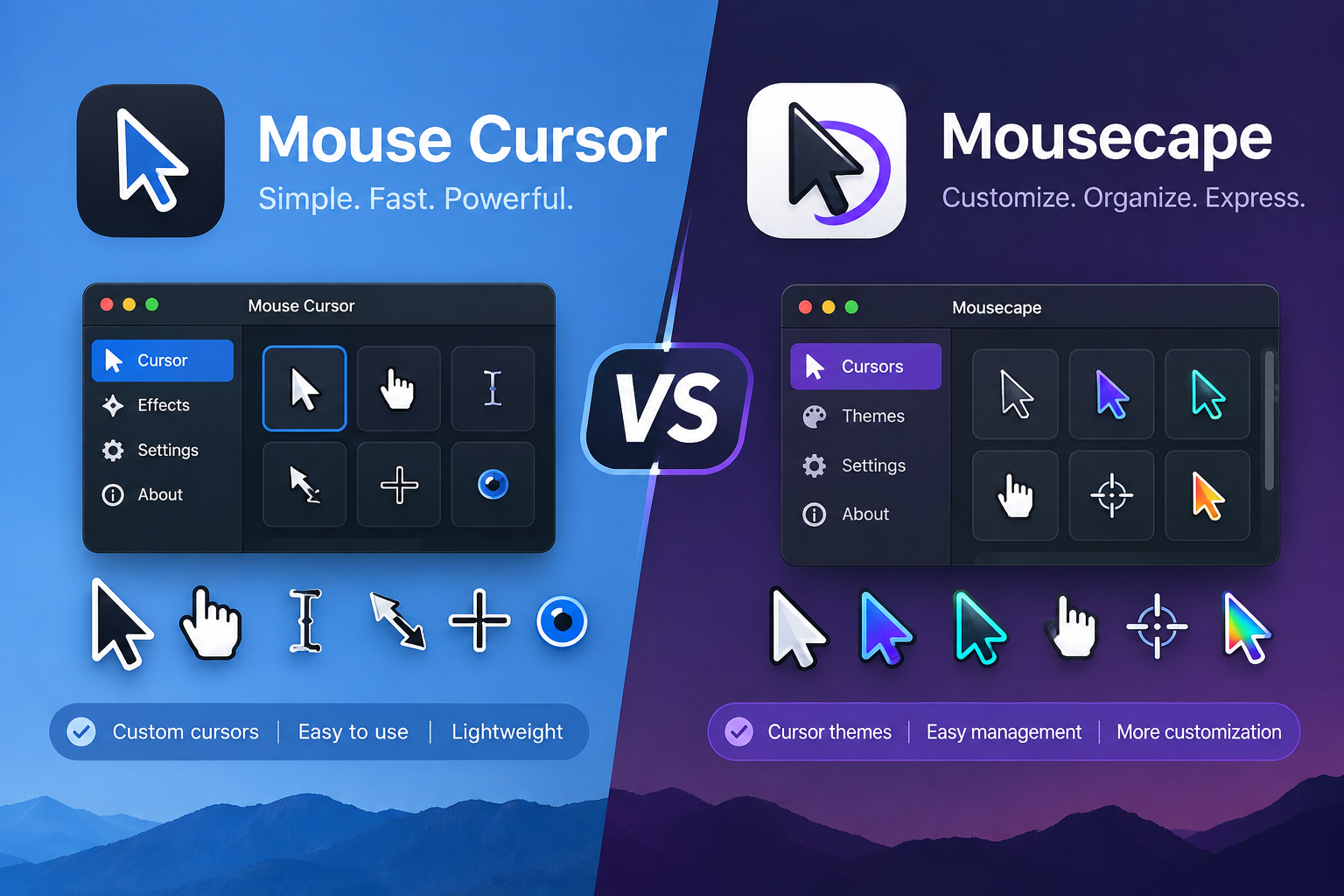
Mouse Cursor and Mousecape are related to the appearance and behavior of the mouse pointer, but they represent different concepts. A mouse cursor is the visual pointer used to interact with elements on a computer screen, while Mousecape is a macOS utility designed to customize the appearance of the cursor.
The two therefore differ significantly in purpose, functionality, compatibility, requirements, and use cases. Comparing them provides a clearer understanding of the standard mouse cursor and specialized cursor-customization software.
Mouse Cursor vs Mousecape: Quick Comparison
| Feature | Mouse Cursor | Mousecape |
| Primary purpose | Provides the standard on-screen pointer | Customizes cursor appearance |
| Cursor customization | Depends on operating system | Core function |
| Cursor themes | System-dependent | Supported through capes/themes |
| Cursor appearance | Usually system-controlled | Highly customizable |
| Mouse movement | Yes | Uses normal mouse movement |
| Click functionality | Yes | Uses normal mouse clicks |
| Operating-system role | Essential | Optional utility |
| macOS support | Yes | Designed for macOS |
| Windows support | Yes | Not its primary platform |
| Linux support | Yes | Not its primary platform |
| Installation required | No for basic cursor | Yes |
| Resource usage | Minimal | Generally low |
| Main focus | Pointer interaction | Cursor customization |
What Is a Mouse Cursor?
A mouse cursor is the graphical pointer displayed on a computer screen. It shows the current location of the pointing device and allows users to interact with buttons, menus, files, applications, and other interface elements.
The cursor can change appearance depending on what the user is doing. For example, it may become an arrow for general navigation, a text-selection pointer when positioned over editable text, or a resize indicator near the edge of a window.
Common Mouse Cursor Features
A standard mouse cursor can provide:
- Pointer positioning
- Visual feedback
- Selection interaction
- Text-selection indicators
- Resize indicators
- Link or clickable-element indicators
- Loading or busy indicators
- Drag-and-drop feedback
- Accessibility-related size or contrast adjustments
The available cursor styles and customization options depend on the operating system.
What Is Mousecape?
Mousecape is a macOS utility focused on changing the visual appearance of mouse cursors. It allows users to apply customized cursor designs rather than relying exclusively on the default system pointer appearance.
Mousecape uses cursor collections known as capes to manage customized cursor appearances. These can alter different pointer states and provide a more personalized desktop experience.
Common Mousecape Features
Mousecape can provide features such as:
- Custom cursor themes
- Cursor appearance changes
- Cape-based cursor management
- Multiple cursor states
- Theme activation and switching
- Custom cursor designs
- Visual personalization
- macOS-focused customization
Its exact behavior and compatibility can depend on the macOS version and the specific cursor cape being used.
Feature Comparison
The main difference is that a mouse cursor is an essential graphical interface element, while Mousecape is a customization utility.
The cursor itself is responsible for displaying pointer position and interaction states. Mousecape does not replace the fundamental role of the cursor; instead, it modifies how certain cursor states appear on supported macOS systems.
This makes the two different in category: one is part of the operating-system interface, while the other is software for personalizing that interface.
Performance Comparison
Both generally have low performance requirements, but they operate at different levels.
Mouse Cursor Performance
A standard mouse cursor is integrated into the operating system and normally has minimal resource requirements.
Its performance can be influenced by:
- Mouse hardware
- Graphics processing
- Display refresh rate
- Operating-system responsiveness
- Driver behavior
- System workload
Modern operating systems generally handle cursor rendering efficiently.
Mousecape Performance
Mousecape adds a customization layer for cursor appearance.
Performance can depend on:
- macOS version
- Cursor theme complexity
- Cursor image size
- System workload
- Graphics behavior
- Compatibility with the current operating system
For ordinary cursor customization, resource usage is generally low, although compatibility can vary after operating-system updates.
Compatibility
Compatibility is one of the most important differences between the two.
A standard mouse cursor is supported by virtually every mainstream desktop operating system, including Windows, macOS, and Linux.
Mousecape is specifically associated with macOS and its compatibility can depend on the macOS version and system configuration.
Mouse Cursor Compatibility
Standard mouse cursors are broadly supported across:
- Windows
- macOS
- Linux
- ChromeOS
- Other graphical desktop environments
The available customization options differ between platforms.
Mousecape Compatibility
Mousecape is primarily designed for:
- macOS desktop environments
- Supported macOS versions
- Compatible cursor formats and capes
Its compatibility should be considered separately from general mouse-cursor support.
System Requirements
Mouse Cursor Requirements
A standard mouse cursor does not normally require separate software installation.
Typical requirements include:
- Compatible operating system
- Functional pointing device
- Display
- Appropriate mouse drivers
The cursor is normally provided as part of the operating system’s graphical interface.
Mousecape Requirements
Mousecape generally requires:
- A compatible Mac
- A supported macOS version
- Mousecape software
- Compatible cursor capes or designs
- Appropriate system permissions when required
Requirements may change as macOS versions evolve.
Ease of Use
The standard mouse cursor requires almost no setup because it is built into the operating system.
Users can generally adjust basic cursor settings through system preferences or accessibility settings.
Mousecape involves additional configuration.
A typical workflow can include:
- Install Mousecape.
- Open the application.
- Obtain or create a compatible cursor cape.
- Import or select the cape.
- Activate the desired cursor appearance.
- Switch or remove themes when necessary.
The exact process can vary depending on the macOS version and cursor package.
Mouse Cursor Use Cases
A standard mouse cursor is used for:
- Navigating the desktop
- Selecting files
- Opening applications
- Clicking buttons
- Selecting text
- Dragging objects
- Resizing windows
- Interacting with graphical interfaces
- Providing visual interaction feedback
It is a fundamental part of graphical computer interfaces.
Mousecape Use Cases
Mousecape can be used for:
- Customizing macOS cursor appearance
- Applying cursor themes
- Personalizing the desktop
- Testing different cursor designs
- Creating a distinctive visual interface
- Switching between cursor styles
Its primary purpose is visual customization rather than basic mouse operation.
Advantages of Mouse Cursor
- Essential for graphical computer interaction
- Supported by virtually all desktop operating systems
- Requires no separate installation
- Provides visual feedback
- Supports multiple pointer states
- Can usually be customized to some extent
- Works with standard mouse hardware
Limitations of Mouse Cursor
- Default appearance can be relatively limited
- Customization depends on the operating system
- Advanced visual customization may require additional software
- Cursor designs can vary between platforms
- Accessibility options may not provide every possible visual style
Advantages of Mousecape
- Provides extensive cursor customization on supported macOS systems
- Supports customized cursor themes
- Allows users to personalize different cursor states
- Can change the visual appearance of the desktop pointer
- Supports cape-based cursor management
- Generally has modest resource requirements
Limitations of Mousecape
- Primarily designed for macOS
- Compatibility can vary between macOS versions
- Requires additional software
- Cursor themes may need to be obtained or created separately
- System updates can affect customization compatibility
- It does not replace the underlying mouse functionality
Mouse Cursor vs Mousecape for Personalization
The standard mouse cursor provides the basic pointer appearance and may offer built-in customization options through the operating system.
Mousecape is specifically focused on deeper visual customization, allowing supported macOS users to apply alternative cursor designs.
The distinction is therefore between built-in cursor functionality and specialized cursor personalization.
Mouse Cursor vs Mousecape for Accessibility
Operating systems commonly provide cursor accessibility features such as:
- Increased cursor size
- Contrast adjustments
- Pointer visibility options
- Pointer-location assistance
- Motion-related settings
These features are designed to make the cursor easier to see and use.
Mousecape, in contrast, is primarily intended for visual customization rather than accessibility. Some custom cursor designs may improve visibility for particular users, but accessibility functionality ultimately depends on the operating system and configuration.
Customization Capabilities
| Customization Feature | Mouse Cursor | Mousecape |
| Cursor size adjustment | Often available | Depends on theme/system |
| Cursor appearance | System-dependent | Core function |
| Custom themes | Limited to platform support | Yes |
| Multiple cursor states | Yes | Yes |
| Custom cursor images | System-dependent | Supported through capes |
| Theme switching | Limited or system-dependent | Supported |
| Accessibility settings | Common | Not its primary purpose |
| Operating-system integration | Native | Customization layer |
| Advanced visual customization | Varies | Strong focus |
Visual Customization
The default mouse cursor is usually designed for clarity and general usability. Its appearance is controlled by the operating system and may include several states for different interactions.
Mousecape focuses on changing these visual states through customized cursor designs.
This can include variations for:
- Normal selection
- Text selection
- Busy states
- Link selection
- Resizing
- Dragging
- Other pointer states
The exact states available depend on the cursor theme.
Reliability and Consistency
A standard mouse cursor is deeply integrated into the operating system, so it generally provides predictable behavior across supported applications.
Mousecape introduces additional customization, meaning compatibility can depend on the macOS version and how individual applications handle cursor rendering.
Potential factors include:
- Operating-system updates
- Application compatibility
- Cursor theme structure
- System permissions
- Graphics behavior
- Theme configuration
Consequently, customized cursor behavior can require additional maintenance compared with the default cursor.
Hardware Considerations
Both the standard cursor and Mousecape depend on a functioning pointing device.
Relevant hardware factors include:
- Mouse sensor
- Polling rate
- Connection type
- Driver support
- Pointer responsiveness
- Display characteristics
Mousecape changes the visual representation of the cursor rather than the fundamental physical operation of the mouse.
Mouse Cursor vs Mousecape for Desktop Customization
A standard mouse cursor is part of the operating system’s desktop environment and provides essential interaction functionality.
Mousecape is specifically useful when the goal is to modify that visual appearance beyond the normal system customization options.
Therefore, users interested in general pointer functionality and users interested in advanced cursor personalization are dealing with two different requirements.
Important Considerations
Cursor customization software should be checked for compatibility with the specific operating-system version being used. Major operating-system updates can change system behavior and potentially affect third-party cursor customization.
Users should also consider cursor visibility and usability when selecting custom designs. A visually attractive cursor may not necessarily provide the same clarity as the default system pointer.
Conclusion
Mouse Cursor and Mousecape are fundamentally different in purpose. A mouse cursor is a core graphical interface element used for pointer navigation and interaction, while Mousecape is a macOS-focused utility for customizing the visual appearance of that cursor.
The standard mouse cursor is broadly available across operating systems and requires no separate installation. Mousecape provides additional customization capabilities through cursor themes and capes but has platform and compatibility considerations.